
Updated according to the Home Office and UK Visas & Immigration (UKVI) guidance as published on GOV.UK
The UK immigration system grants Indefinite Leave to Remain (ILR) through several pathways, but the two most widely used are the 5-year settlement route and the 10-year long residence route. The regulations governing these pathways are set and maintained by the UK Home Office, specifically the branch known as UK Visas and Immigration (UKVI). All rules are formally approved through changes to the Immigration Rules, which are laid before the UK Parliament under the authority of the Secretary of State for the Home Department.
According to the official guidance published on GOV.UK, and reinforced by detailed analysis provided by the House of Commons Library (UK Parliament), these routes determine when different visa holders can apply for settlement based on their role, visa type, and the continuity of their lawful residence. The most recent clarifications were issued between 2023–2025, with ongoing consultations for a future reform that may expand the qualifying period to 10 years for most working visa routes. The planned change to make the standard qualifying period for Indefinite Leave to Remain (ILR) from 5 years to 10 years is not yet approved and is still under consultation. What is approved and already in force is the existing 10-year “long residence” ILR route (for those who have already completed 10 years of lawful UK residence) under the current rules.
The 5-Year ILR Route: Who qualifies?
The 5-year settlement route applies to individuals on visas that explicitly include a pathway to ILR after five years of continuous lawful residence. This route is confirmed in multiple Home Office policy documents and official GOV.UK guidance pages—particularly the Skilled Worker ILR guidance updated by the UKVI and approved by the Home Secretary.
1. Skilled Worker Visa (including NHS Nurses, Doctors, Engineers, IT Specialists, Teachers, etc.)
According to the Home Office’s “Indefinite Leave to Remain (Skilled Worker Route)” guidance, last updated in alignment with UKVI regulations, these applicants qualify for ILR after 5 years, provided continuous residence and salary thresholds are met. This is the route used by most healthcare professionals, engineers, technical staff, and other skilled migrants contributing to the UK workforce.
2. Health and Care Worker Visa (Nurses, Carers, Medical Professionals)
Introduced in 2020 and upheld under UKVI policy, this visa is a sub-route of the Skilled Worker route. It explicitly allows ILR after 5 years. This pathway was approved by the Home Secretary and published on GOV.UK as part of the UK’s post-Brexit immigration policy.
3. UK Ancestry Visa
The UK Ancestry Visa provides a 5-year route to settlement for eligible Commonwealth citizens with UK ancestry. This route has existed for decades and continues to be recognised in ongoing Home Office policy statements.
4. Hong Kong BN(O) Visa
Launched in January 2021 following approval by the Secretary of State and published on GOV.UK, the BN(O) scheme grants ILR eligibility after 5 continuous years of lawful residence.
5. Business & Investment Routes (Innovator, Investor, etc.)
Where applicable, these routes offer settlement after 5 years, subject to meeting innovation, business, or investment criteria. These rules are upheld through UKVI guidance and approved via legislative updates to the Immigration Rules.
Collectively, these visas represent the largest group of migrants who remain eligible for ILR under the 5-year route as of the latest published Home Office regulations.
The 10-Year ILR Route: Long Residence and Other Non-Settlement Visas
The 10-year long residence route is regulated through the Immigration Rules Part 7 and is designed for individuals who have accumulated 10 years of continuous lawful residence across various visa categories—regardless of whether their visas individually lead to settlement.
This route was confirmed in Home Office guidance titled “Long Residence”, approved under the authority of the Secretary of State and published on GOV.UK. Updates were made periodically by UKVI, with notable refinements in 2023 and 2024.
Who falls under the 10-year category?
-
Individuals who have lived lawfully in the UK on multiple visa types, such as Student → Graduate → Skilled Worker (without completing 5 years in a settlement route).
-
Those on visas that do not provide a direct path to settlement, such as:
-
Student visas
-
Youth Mobility Scheme
-
Temporary Worker visas (formerly Tier 5)
-
Visitor visas (not eligible for counting)
-
Graduate Route visas
-
Seasonal Worker visas
-
For these individuals, ILR becomes available only once 10 continuous years of lawful UK residence are met, and only if absences and visa compliance conditions fully satisfy UKVI requirements.
Government Approvals and Regulatory Bodies
The rules summarised above are enforced and approved through:
1. UK Home Office
Specifically, the Secretary of State for the Home Department, who has the legal authority to introduce and amend immigration rules.
2. UK Visas and Immigration (UKVI)
The operational branch that issues guidance, interprets immigration rules, and manages ILR applications.
3. UK Parliament
Certain rule changes—especially major ones—are laid before Parliament and documented by the House of Commons Library, which analyses and certifies updates for public understanding.
4. Home Office Published Guidance on GOV.UK
This is the definitive and legally recognised source.
Key pages include:
-
ILR: Skilled Worker Route
-
ILR: Long Residence (10-year rule)
-
BN(O) Route Settlement Rules
-
Ancestry Visa Guidance
These documents collectively establish the binding criteria for settlement.
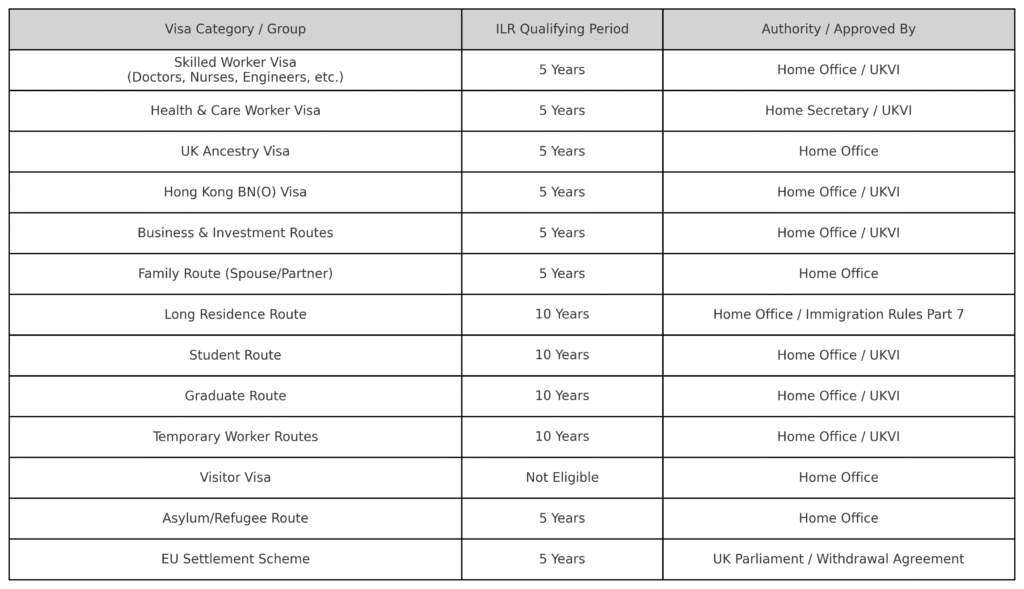
In the nutshell, the Skilled Worker visa—covering professions such as NHS nurses, doctors, engineers, and other technical or managerial occupations—qualifies for ILR after five years, as confirmed by UKVI and listed on GOV.UK’s “Indefinite Leave to Remain: Skilled Worker” page. The Health and Care Worker visa, a specialised variant prioritising healthcare roles, also leads to ILR after five years. Visas such as the UK Ancestry route and the Hong Kong BN(O) route similarly offer a five-year settlement path. Certain business and innovation visas also qualify, depending on compliance with business performance criteria.
In contrast, individuals who have accumulated lawful residence through various visas without a direct settlement pathway must rely on the 10-year long residence option, as established under Part 7 of the Immigration Rules and maintained by UKVI. This route includes those on student visas, graduate visas, temporary work visas, and other non-settlement categories. The Home Office continues to monitor and revise these rules, with current proposals suggesting a potential shift toward a unified 10-year settlement structure for many working categories—though these changes are not yet fully enacted.
Disclaimer: This article is for general information only and does not constitute legal or immigration advice. UK immigration rules may change, so always check the latest official UK Government guidance before making any decisions.